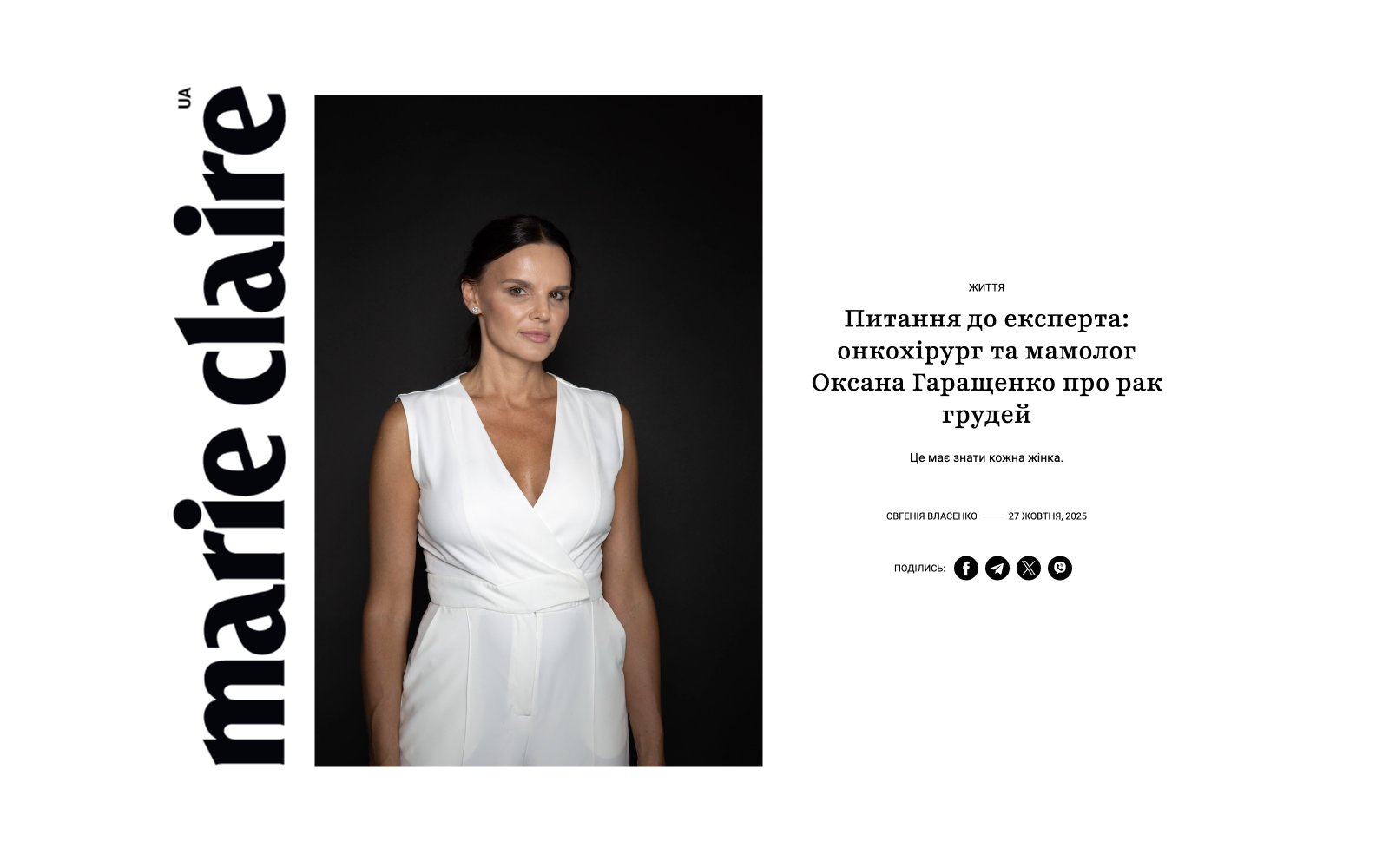
Marie Clarie. Question to the expert: oncologist and mammologist Oksana Garashchenko about breast cancer
Every year, more than 2.3 million cases of breast cancer are diagnosed in the world, and almost 680 thousand women lose their lives to this disease. Such shocking data is provided by the World Health Organization. However, there is also encouraging news: if cancer is detected in the early stages, the chances of a full recovery can reach 90%.
October is traditionally considered Breast Cancer Awareness Month - a time when the world emphasizes the importance of prevention, self-control and timely consultation with a doctor.
That is why, together with oncologist and mammologist Oksana Garashchenko, we decided to remind you how to recognize threatening symptoms, what examinations should be regularly performed and why it is extremely important for every woman.
Ms. Oksana, tell us in more detail what breast cancer is and who is at risk?
Breast cancer is a malignant tumor whose cells divide continuously, lose control of their growth, and are able to spread throughout the body, forming metastases. The causes of this disease are multifactorial - there is no single one that would explain its development.
The group at increased risk primarily includes women with a hereditary predisposition. This includes cases where close relatives have had breast, ovarian, prostate cancer, or several types of cancer at the same time. Particular attention should be paid to situations where one person has several tumor locations or when there are several cancer patients in the family - especially with diseases of the glandular organs.
Another important factor is a disruption in the immune system, which normally controls cell division and prevents the formation of tumors. The state of immunity largely depends on the level of stress, hormonal balance, physical activity, body weight, as well as the presence of bad habits - smoking, drinking alcohol, or excessive use of hormonal drugs without medical supervision.
At the same time, it is worth remembering: the presence of risk factors does not necessarily mean the occurrence of cancer, but only increases the likelihood of its development.
What are the types of breast cancer?
Types of breast cancer are divided by the place of origin and the characteristics of the tumor cells.
Depending on where the tumor begins to develop, there are ductal cancer, which forms in the milk ducts and is the most common type, and lobular cancer, which develops in the lobules of the gland where milk is formed. There are also rare forms of breast cancer - these are sarcomas and other tumors that arise from atypical tissues within the breast.
According to molecular characteristics, tumor cells are divided into several subtypes. Hormone-dependent cancer grows under the influence of female hormones, HER2-positive is characterized by an increased level of the HER2 protein, and triple-negative cancer does not have hormone receptors and is usually more aggressive.
Is it possible to recognize breast cancer in its early stages? What are its symptoms?
In fact, in the early stages, breast cancer often has no pronounced symptoms. However, over time, there may be enlarged lymph nodes, a lump in the breast or under the armpit, changes in the shape or size of the breast, nipple retraction, nipple discharge, or skin changes on the breast, such as redness, "orange peel".
Symptoms can be different for different patients, so even minor changes should be discussed with your doctor.
How to prevent breast cancer?
We often hear about palpation and self-examination of the breast as a way to detect breast cancer. However, modern medical recommendations no longer consider these methods effective for early diagnosis. The only reliable way to detect or prevent the development of oncology in a timely manner is regular preventive examinations by a mammologist. Depending on age and individual risk level, the doctor may prescribe ultrasound, mammography or other instrumental diagnostic methods.
Even an experienced specialist cannot make an accurate diagnosis just by palpation. Small tumors, for example, less than one centimeter in size, are often impossible to feel by touch. In women with large breasts or in cases where the tumor is located deeper - closer to the muscle tissue - the neoplasm is also easy to miss. That is why regular examinations using special equipment are the basis of caring for women's health.
To prevent breast cancer, it is also important to pay attention to your lifestyle. Maintain a healthy weight, stay physically active, eat a balanced diet, control your hormonal balance and stress levels. And, of course, give up alcohol and smoking - this is one of the most effective steps on the way to maintaining health.
What diagnostic methods are used for breast cancer?
There are many high-quality diagnostic methods that help doctors diagnose and respond promptly to the disease. Mammography is the best method for detecting breast tumors in the earliest stages, when they are asymptomatic. It is the primary diagnostic method for women over 40.
Breast ultrasound is performed at any age in women and men as a standalone or complementary examination. It provides information about the structure of the glands and the size and structure of regional lymph nodes.
MRI can be used as an adjunct if ultrasound and mammography findings are inconsistent. It allows for the evaluation of glandular structure.
At the same time, a biopsy is performed to obtain a sample of an existing tumor. Various types of biopsy are used in mammology. For example, a core biopsy (trephine biopsy) provides a tissue sample for histological analysis and precise determination of the tumor type. A fine-grain aspiration biopsy provides cells for cytological examination. It is used to evaluate nipple discharge, cystic lesions, and suspicious lymph nodes.
The doctor may also order immunohistochemistry. This is a type of histology that helps determine the molecular subtype of the tumor and select the most effective treatment.
What are the available breast cancer treatments?
Breast cancer treatment is individualized and depends on the stage of the disease, tumor size, type, and the patient's overall condition. It necessarily involves a combination of several methods and is considered specialized medical care. Surgical treatment is most commonly used—tumor removal or breast-preserving surgery (oncoreconstruction is a type of surgical treatment).
Chemotherapy can be administered before or after surgery. It attacks cancer at the cellular level, destroying tumor cells in the body. Radiation therapy is administered locally to destroy residual cancer cells after surgery.
Antihormonal therapy is used for hormone-dependent tumors. Targeted therapy targets specific tumor cell sensors. Immunotherapy is used less frequently, primarily in metastatic cases.
What happens if breast cancer is left untreated?
If breast cancer is left untreated or unproven treatments, such as homeopathy, are used, the tumor will progress, destroying surrounding tissue and metastasizing.
Initially, the lymph nodes become enlarged, where the tumor metastasizes regionally. Subsequently, metastases spread throughout the body—to the bones, lungs, liver, or brain.
Without timely and adequate treatment, cancer leads to severe complications and death. The earlier treatment is started, the higher the chances of a full recovery.
Photo: personal archive, Freepik